
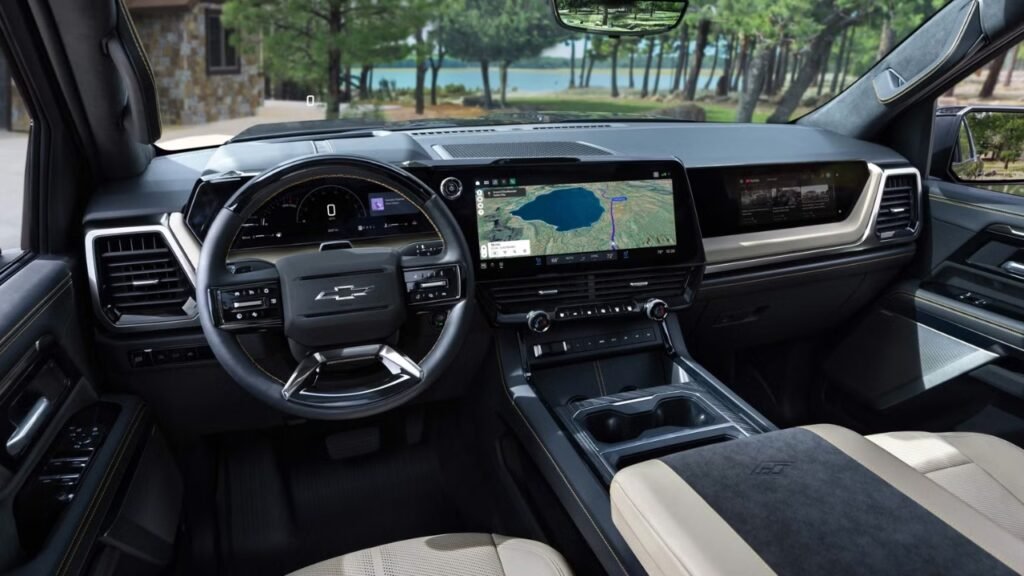
2026 Chevy Silverado Gets a Major Software Upgrade That Could Change GM Trucks
The pickup truck market is changing in ways that would have seemed unusual just a few years ago. Buyers still care about towing strength, engine performance, payload, durability, and fuel economy, but technology is becoming almost as important as what sits under the hood. Chevrolet’s Silverado is now moving deeper into that transition, with software becoming a major part of the truck’s overall experience.
For 2026, the Silverado story is about more than horsepower or a redesigned grille. The bigger conversation is about how GM is building a truck that can become smarter, more connected, and easier to update over time. That shift could have consequences far beyond one model year, particularly as General Motors prepares its next generation of pickup technology.
The Silverado Is Entering a New Digital Era
Traditional vehicles were largely finished products when they reached the customer. If an owner wanted a meaningful technology upgrade, the usual solution was to trade the vehicle for a newer model.
That model is gradually disappearing.
Modern connected vehicles can receive software improvements remotely, allowing manufacturers to change or add functions without requiring the vehicle to return to a dealership for every update. For Silverado owners, this creates a very different ownership experience.
Instead of thinking of the truck’s software as something permanently fixed at purchase, drivers can increasingly expect updates to improve the digital side of the vehicle during ownership.
That is an important change for Chevrolet because pickup buyers tend to keep their trucks for years. A technology system that can remain current for longer could become a major selling point.
More Than Just a Bigger Touchscreen
It is easy to look at modern truck technology and assume the biggest change is the size of the center display. But GM’s software direction goes much further than adding another large screen to the dashboard.
The goal is to make important information easier to find while reducing the number of steps required to control common functions.
A truck can have an enormous display and still be frustrating if drivers have to search through several menus to find trailer information, camera views, climate controls, or vehicle settings.
Chevrolet’s approach is increasingly focused on organizing these functions around the way people actually use a pickup. That becomes particularly important when the truck is being used for towing, hauling, off-road driving, or long-distance travel.
Trailering Could Become One of the Biggest Beneficiaries
Few areas of truck ownership benefit from better software as much as towing.
Connecting a trailer introduces a long list of things that drivers need to monitor. Lighting, trailer settings, camera views, tire information, and other details can quickly become difficult to manage.
A more intelligent software system can bring these functions together instead of forcing the driver to search through unrelated menus.
Future Silverado technology is expected to make trailer-related information more visible and easier to access. The concept is simple: when the truck knows that a trailer is attached, the interface should be able to prioritize information relevant to towing.
That sounds like a small convenience, but frequent towing can turn small improvements into significant time savings.
Smartphone Integration Is Becoming More Important
Another major part of the Silverado’s digital evolution is the relationship between the truck and the driver’s smartphone.
For many people, the phone is already the center of their digital life. Navigation, music, communication, appointments, and other services are handled through mobile apps every day.
The challenge for automakers is creating a vehicle interface that works alongside the phone rather than making the driver choose between two separate systems.
GM’s newer software strategy is designed to bring vehicle information and smartphone-based services together more naturally. That can make the cabin feel less like a collection of unrelated technologies and more like one connected system.
For Silverado buyers, this could be especially useful during road trips, workdays, and towing trips where navigation and vehicle information need to be available at the same time.
Artificial Intelligence Could Change How Drivers Interact With the Truck
Artificial intelligence is another piece of GM’s broader software strategy.
AI inside a vehicle does not necessarily mean having a chatbot sitting on the dashboard. The more interesting possibility is an assistant that understands the vehicle itself.
Imagine a system that can help explain warning messages, provide information about vehicle functions, answer questions about towing procedures, or guide the driver through settings without requiring a search through the owner’s manual.
GM has been expanding its relationship with Google and introducing Gemini capabilities into compatible vehicles. That development suggests that conversational technology could become a normal part of the company’s future vehicle interfaces.
For truck owners, the value will ultimately depend on how well these systems understand practical vehicle-related questions rather than simply providing generic answers.
Software Could Extend the Life of the Truck
One of the most interesting consequences of this shift is what it could mean several years after purchase.
A truck that receives regular software updates may not feel exactly the same throughout its entire ownership period. New functions can potentially be introduced, existing features can be refined, and bugs can be addressed without requiring a completely new vehicle.
That does not mean every Silverado will receive every new feature. Hardware limitations will always matter. But the basic idea changes expectations around vehicle ownership.
Instead of buying a truck with technology that gradually becomes outdated, customers could have a system that evolves within the limits of its hardware.
That could be particularly valuable in the pickup market, where owners often keep their vehicles for a long time.
GM Is Also Redesigning the Bigger Silverado Experience
The software developments surrounding the Silverado are part of a much larger transformation at GM.
The company is preparing its next generation of pickups with a stronger emphasis on software-defined vehicle architecture. The next Silverado generation is expected to combine traditional truck capabilities with a significantly more advanced digital environment.
That means the 2026 model year can be viewed as part of a transition rather than an isolated technology upgrade.
GM is essentially testing and developing the pieces of an ecosystem that will become increasingly important across future Chevrolet and GMC trucks.
The Hardware Still Matters
Despite all the attention surrounding software, Chevrolet cannot afford to forget what makes a pickup a pickup.
Truck buyers still expect strong engines, dependable transmissions, useful payload capacity, towing capability, durable suspension systems, and practical bed configurations.
Software can make those mechanical abilities easier to use, but it cannot replace them.
The most successful future Silverado will likely be the one where technology stays in the background when it is not needed and becomes useful exactly when the driver needs assistance.
That balance could be more important than simply adding more screens or digital features.
Why This Could Be a Big Deal for GM Trucks
The real significance of the Silverado’s software evolution is not one particular update. It is the direction GM is taking.
Pickup trucks are becoming connected platforms where mechanical engineering and software development work together. Chevrolet can use software to improve the ownership experience, organize truck-specific information, introduce new capabilities, and keep compatible systems more current.
If GM manages to make those improvements without overwhelming drivers with unnecessary complexity, the Silverado could help establish a different standard for what buyers expect from a modern pickup.
The truck will still need to tow, haul, work, and survive demanding conditions. But increasingly, it will also need to communicate with its driver, understand how it is being used, and adapt to changing technology.
That is the bigger story behind the Silverado’s software push. The next major evolution of GM trucks may not be defined by one engine or one body design. It could be defined by how much the truck can learn, connect, and improve after it reaches the owner’s driveway.
