
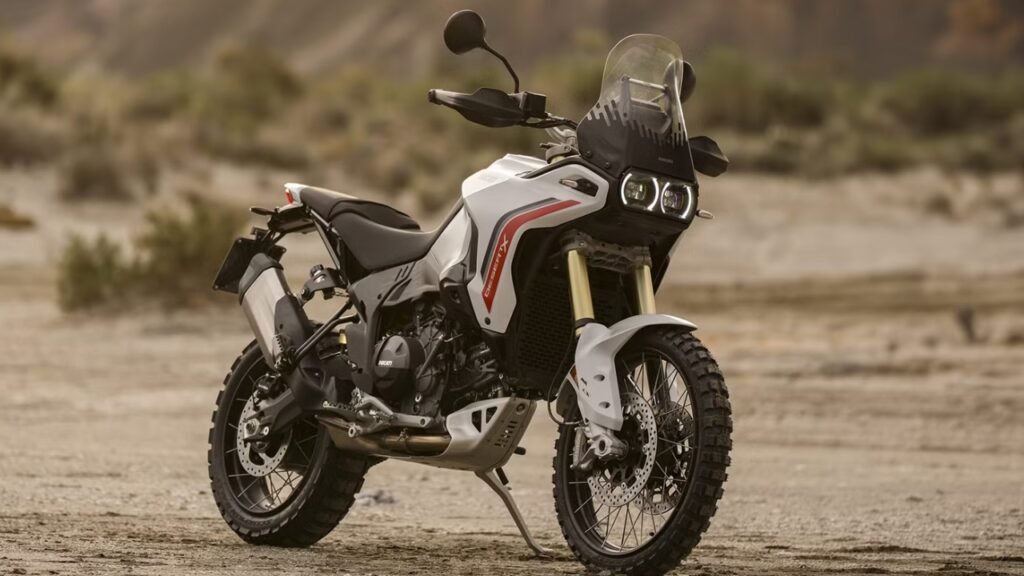
2026 Ducati DesertX Drops Desmodromic Valves-Here’s What’s Changing Under the Skin
Ducati is making a surprisingly significant engineering change to its adventure motorcycle lineup for 2026. The DesertX is moving away from the brand’s famous desmodromic valve system, a technology that has been closely connected with Ducati motorcycles for generations.
At first glance, this may look like a technical detail that only engine enthusiasts would care about. In reality, it could have a noticeable impact on the way Ducati approaches adventure motorcycles in the years ahead. The DesertX has always been a motorcycle built around a balance of performance and long-distance usability, and its latest mechanical direction appears to reflect those priorities more clearly.
What Is Changing Inside The DesertX Engine
The major change is the move from Ducati’s traditional desmodromic valve arrangement to a conventional spring-operated system.
In a conventional four-stroke engine, valve springs help return the intake and exhaust valves to their closed positions after they are opened by the camshaft. Ducati’s desmodromic system takes a different approach, mechanically controlling both the opening and closing of the valves.
That technology has been one of Ducati’s defining engineering signatures. It has allowed the company to develop engines with strong performance characteristics while becoming an unmistakable part of the brand’s identity.
The 2026 DesertX is taking a different path. Instead of relying on desmodromic hardware, Ducati is using a more conventional solution that makes greater sense for the specific role of an adventure motorcycle.
How The New Valve System Fits The DesertX
The DesertX does not have the same job as one of Ducati’s high-performance road machines.
An adventure motorcycle has to cope with dramatically different conditions. It may spend hours cruising on a highway before being taken onto dirt roads, loose surfaces, rocky trails, or steep climbs. Riders also expect it to remain manageable when carrying luggage and traveling long distances.
That changes the engineering priorities.
Peak horsepower is only one part of the equation. Smooth torque delivery, predictable throttle response, durability, efficiency, and ease of maintenance can be equally important. A conventional valve arrangement gives Ducati another way to optimize the engine around those real-world requirements.
The result is a motorcycle that does not need to rely on exotic mechanical solutions simply for the sake of maintaining tradition.
What This Could Mean For Maintenance
One of the most interesting consequences of the change is likely to be found away from the road.
Valve adjustment is an important part of motorcycle maintenance, and Ducati’s desmodromic arrangement has traditionally required a more specialized servicing procedure than a conventional valve train. That can make scheduled maintenance more involved and potentially more expensive depending on the motorcycle and service requirements.
The move to conventional valve springs gives Ducati an opportunity to simplify the engine’s mechanical architecture.
For an adventure bike, that is especially relevant. Owners can accumulate substantial mileage during touring, and many riders buy these motorcycles specifically because they want to travel long distances. Anything that makes routine ownership more straightforward can therefore have genuine value.
It does not mean the DesertX suddenly becomes maintenance-free. Adventure motorcycles still require regular attention to fluids, filters, chains, brakes, suspension components, tires, and other wear items. The point is that Ducati is reducing complexity in one of the engine’s core systems.
How Much Ducati Character Will Remain
The obvious concern among Ducati fans is whether losing desmo also means losing some of the character associated with the brand.
There is no reason to assume that the personality of the DesertX depends entirely on its valve train. Engine character comes from a much larger combination of factors, including combustion characteristics, crankshaft design, intake and exhaust tuning, gearing, fueling, electronics, and the way power is delivered.
The DesertX has always been about more than chasing the highest possible engine speed.
Its appeal comes from combining Ducati performance with the versatility expected from an adventure machine. That means strong acceleration, useful torque, responsive handling, and a distinctive riding experience remain important even with a different valve system.
In other words, the technology underneath the tank may change without fundamentally changing what makes the motorcycle appealing.
What Adventure Riders Could Gain
Adventure riders tend to judge motorcycles differently from sportbike buyers.
A rider planning a multi-day trip may care more about how easily the motorcycle covers 500 miles than about its ultimate top speed. Someone heading into remote terrain may value predictable engine response more than a few additional horsepower at the top of the rev range.
The 2026 DesertX’s new direction seems well matched to those priorities.
A simpler valve arrangement could help Ducati concentrate on long-term usability while retaining the performance expected from the brand. It may also make the motorcycle more approachable for riders who have previously viewed Ducati adventure bikes as technically sophisticated but potentially demanding machines.
That could be particularly relevant as the adventure segment continues to attract riders who use one motorcycle for commuting, touring, and off-road exploration.
How Ducati Is Balancing Tradition And Modern Needs
The decision becomes even more interesting because Ducati has spent decades building its reputation around desmodromic technology.
Changing that formula demonstrates that the company is willing to treat its engineering heritage as a tool rather than an unchangeable rule. Ducati can continue using desmo where its engineers believe it delivers the desired benefits while adopting different solutions on motorcycles with different missions.
That distinction is important.
Technology that makes sense on a track-focused motorcycle does not necessarily provide the same advantage on a machine designed to cross countries and tackle unpredictable terrain. Adventure motorcycles have their own set of compromises, and the DesertX needs to satisfy those requirements.
The 2026 model shows Ducati adapting its engineering philosophy to the motorcycle rather than forcing every model into the same technical formula.
What The Change Says About Ducati’s Future
The DesertX could be an early sign of a broader evolution in Ducati’s approach to engine technology.
Modern motorcycle development involves more than performance figures. Manufacturers have to consider emissions, fuel efficiency, reliability, production complexity, servicing, weight, and the expectations of riders in different markets.
That makes engineering flexibility increasingly valuable.
Ducati’s decision to remove desmodromic valve actuation from the DesertX does not erase the importance of desmo in the company’s history. Instead, it suggests that Ducati is becoming more selective about where that technology makes sense.
For buyers, the important question will ultimately be how the complete motorcycle performs and behaves rather than which valve mechanism sits inside the engine.
How The 2026 DesertX Could Change The Adventure Formula
The most fascinating aspect of the 2026 Ducati DesertX is that its biggest update is something riders cannot easily see.
The motorcycle still carries the visual identity and adventurous purpose that made the DesertX stand out, but underneath the bodywork Ducati has made a decision that challenges one of its most recognizable engineering traditions.
That could make the new DesertX more practical without making it less distinctive.
For Ducati, this is a calculated shift toward matching technology with purpose. For riders, it could mean an adventure motorcycle that focuses more heavily on usability, servicing, and long-distance ownership while preserving the performance and character expected from the Italian manufacturer.
The disappearance of desmo from the DesertX may therefore be less about Ducati abandoning its past and more about the company deciding what its adventure motorcycles need for the future.
